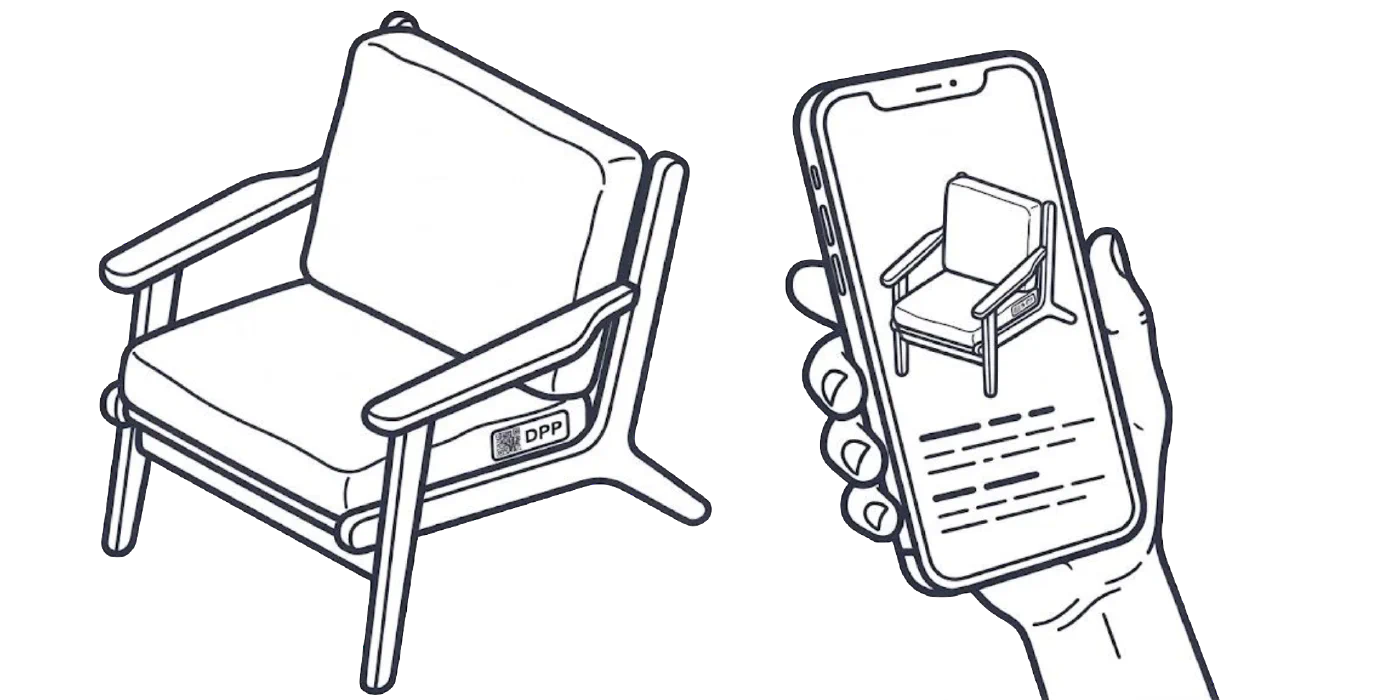
In the furniture industry, most conversations about the Digital Product Passport (DPP) are about deadlines. Furniture is one of the priority product groups in the European Commission’s first working plan under the Ecodesign for Sustainable Products Regulation (ESPR). For wooden furniture, the EU Deforestation Regulation (EUDR) adds due diligence on where the timber was harvested.
Beyond compliance, the passport also gives manufacturers something new: a direct link to every piece after delivery. Today, furniture gets assembled, claimed under warranty, extended, refurbished and passed on, and the manufacturer rarely hears about any of it. A Digital Product Passport keeps that link alive: a QR code or NFC tag on the piece that leads to its assembly guide, spare parts and accessories for as long as it is in use.
In this article we follow one modular wardrobe through its first four years to show how a Digital Product Passport adds value: from the assembly on day 1, to a warranty claim in week 1, to an extension in year 4.
1. Digital Assembly Instructions, Care and Material Information
Furniture still ships with a stack of paper: assembly instructions in a dozen languages, warranty cards and care leaflets. Printing and packing them costs money on every order, and most of it goes out with the cardboard once the piece is standing. Years later, when the owner wants to oil the tabletop or take the wardrobe apart for a move, the instructions are gone, and the question lands with customer service.
A Digital Product Passport keeps that information with the piece:
- Interactive Assembly and Disassembly Guides: Step-by-step instructions with zoomable 3D views and short videos, for customers and professional fitters alike.
- Care Instructions That Stay Current: Advice for surface finishes, leather or wood oil, updated without a reprint.
- Material and Origin Details: Wood species, materials and certificates such as FSC or PEFC. For wooden furniture covered by the EUDR, the passport can also hold the reference number of the due diligence statement.
- Less Paper in the Box: Fewer printed inserts mean less printing, smaller packaging and less freight weight across thousands of shipments. For products covered by a delegated act, ESPR allows the instructions to move into the passport. Safety information stays on paper, and customers can request a free printed copy of the instructions.
Assembling a Modular Wardrobe System
A customer receives a three-door modular wardrobe with interior drawers, delivered flat-packed.
The enclosed assembly guide is a 48-page booklet with dense black-and-white diagrams. When aligning the doors and hinges, the customer gets stuck: the small diagrams make it nearly impossible to tell left and right parts apart. Frustrated, they call customer support or mount parts backward, leaving the doors hanging crooked.
The customer scans the QR code on the inside of the cabinet frame. The assembly guide opens with zoomable 3D steps and a 20-second video on adjusting the door gaps. The doors hang straight, and no booklet ends up in the recycling.
2. Faster Warranty Claims and the Right Spare Part
When a hinge arrives damaged, a soft-close damper jams or shelf pins are missing from the hardware pack, the fix itself is small. Finding the right part is not: customers describe parts in their own words, send unclear photos and cannot find a part number. Customer service spends days on emails confirming the receipt, the finish and the production batch before anything is shipped.
Scanning the passport sends that context along with the claim:
- No Hunting for Part Numbers: Model variant, production batch and part numbers are linked to the code, so nobody has to look for a stamped number on the back panel.
- Claims With Photos: Customers mark the faulty part and upload photos in the passport, which creates a complete service ticket.
- Same-Day Dispatch: Without the back-and-forth, customer service can ship the replacement part on the day the claim arrives.
Missing Hardware and Wardrobe Claim
While fitting the wardrobe’s interior drawers, the customer finds that one soft-close damper is defective and two shelf pins are missing from the hardware pack.
The customer sends a vague email to the retailer: “broken plastic hinge part and two metal pins missing.” The retailer asks for the order receipt, photos and the batch code stamped on the back panel. After ten days of waiting, a package arrives with hardware from a newer revision that does not fit the pre-drilled holes.
The customer scans the code inside the wardrobe and reports the faulty damper and the two missing shelf pins in under a minute. The claim reaches the manufacturer with the exact model and production batch attached, so there are no follow-up questions, and the matching original parts ship that afternoon.
3. Accessories, Refurbishment and a Second Life
Good wardrobes, dining tables and modular shelving stay with their owners for many years, while rooms and needs change. When an owner wants to extend or refresh a piece, the invoice and the exact model name are usually long gone, and the product line may no longer be sold. Without a direct line to the manufacturer, they buy third-party organizers that do not quite fit, or replace the piece altogether.
With a Digital Product Passport, the manufacturer stays within reach for the whole life of the piece:
- Accessories That Fit: The code inside the frame remains the first place to look for extra shelves, interior drawers or replacement handles that fit this exact model.
- Refurbishment Instead of Replacement: A refurbisher sees the disassembly sequence and the original fabric and foam specifications, so a worn-out sofa gets new upholstery instead of going out with the bulky waste.
- Ready for the Next Owner: Materials and dimensions stay with the piece, which makes repairs, handing it down or reselling it easier.
Wardrobe Expansion After Several Years
Four years after buying the wardrobe, the owner needs more storage and wants to add two interior drawers and matching shelves.
The invoice and the exact model name are forgotten, and the internal dimensions are unclear. The retailer’s webshop no longer lists the product line. Frustrated, the customer buys generic storage boxes from a third party, and the manufacturer misses the sale.
Scanning the code inside the wardrobe shows the accessories that fit this exact model and width. The customer orders the matching drawer inserts in two clicks. The wardrobe stays in use for years longer, and the manufacturer makes a sale it would otherwise have missed.
Frequently Asked Questions: Digital Product Passports for Furniture
When does the Digital Product Passport become mandatory for furniture?
Furniture is one of the priority product groups in the Commission’s first ESPR working plan. The passport becomes mandatory once the Commission adopts the delegated act for furniture, which will set the required data points and the date from which they apply. Under ESPR, that date is at least 18 months after the act enters into force.
For wooden furniture, the EU Deforestation Regulation (EUDR) is the more immediate obligation. It does not require a passport, but it does require due diligence on where the timber comes from, down to the geolocation of the plot where it was harvested. The passport is a practical place to keep that evidence linked to the product.
What information will a furniture passport have to contain?
The exact data points will come with the delegated act for furniture. ESPR already names the product aspects such acts draw on, among them durability, repairability, recycled content, recyclability and environmental footprint. It also requires that substances of concern can be tracked through the passport: which substances, where in the product and in what concentration. For furniture, that concerns coatings, adhesives and flame retardants in upholstery foam, data that usually sits with suppliers.
Can the QR code be integrated without spoiling the design?
Yes. The code needs to be easy to find when someone needs it, not visible when someone looks at the piece. ESPR allows the data carrier on the product, its packaging or the documents that come with it, and the delegated act for furniture will specify which. A code on the carton may be enough to comply, but it goes out with the cardboard. Manufacturers that want the code to work for years put it on the piece itself:
- Laser engraving on hidden metal brackets or under tabletop edges.
- Woven textile labels stitched into upholstery seams.
- Concealed NFC or RFID chips embedded in veneer or internal framing.
- Durable QR labels on the underside of chair shells, desks or cabinet bases.
Can fitters and owners open the passport without installing anything?
Yes. The code under the tabletop or on the cabinet base is read by the camera app that is already on every phone and tablet, and the passport opens in the browser. That matters on an installation site, where a fitter assembles pieces from several manufacturers and cannot install one app per brand. It matters just as much years later, when the owner of a second-hand sideboard needs the right hinge and has never heard of the original dealer. In contract furniture, facility managers can open the record of every piece on an office floor the same way, one scan at a time.
Do dealers and refurbishers see more than the person living with the piece?
Yes, and that separation is intended. ESPR requires access to the passport to be granted by role (see our guide to DPP access rights for repairers and service partners), and it names professional repairers, refurbishers and remanufacturers as their own group next to customers and authorities; the delegated act for furniture will define the exact rights. In practice, the owner of a sofa sees assembly instructions, care advice, material declarations and recycling guidance. An authorized dealer or contract installer who signs in additionally gets joinery schematics, hardware order codes and the warranty claim form. A refurbisher preparing the piece for a second life gets the disassembly sequence and the original fabric and foam specifications. Supplier pricing and design files are simply not part of the passport, so no role can open them.
Conclusion: Furniture Compliance as a Lifetime Customer Channel
For furniture manufacturers, the Digital Product Passport is more than another EU reporting obligation. Placed on the piece itself, it keeps a line open to every customer: assembly guides that prevent support calls, warranty claims solved with the right part the first time, and accessory and refurbishment sales years after delivery. Manufacturers that treat the code as part of the product, not as a compliance label, turn a regulation into a lasting customer channel.
To keep implementation straightforward, itemactive provides the white-label DPP platform to connect passports to your furniture without replacing your existing ERP or PIM systems.